
How to Scale Mail Operations Without Scaling Headcount
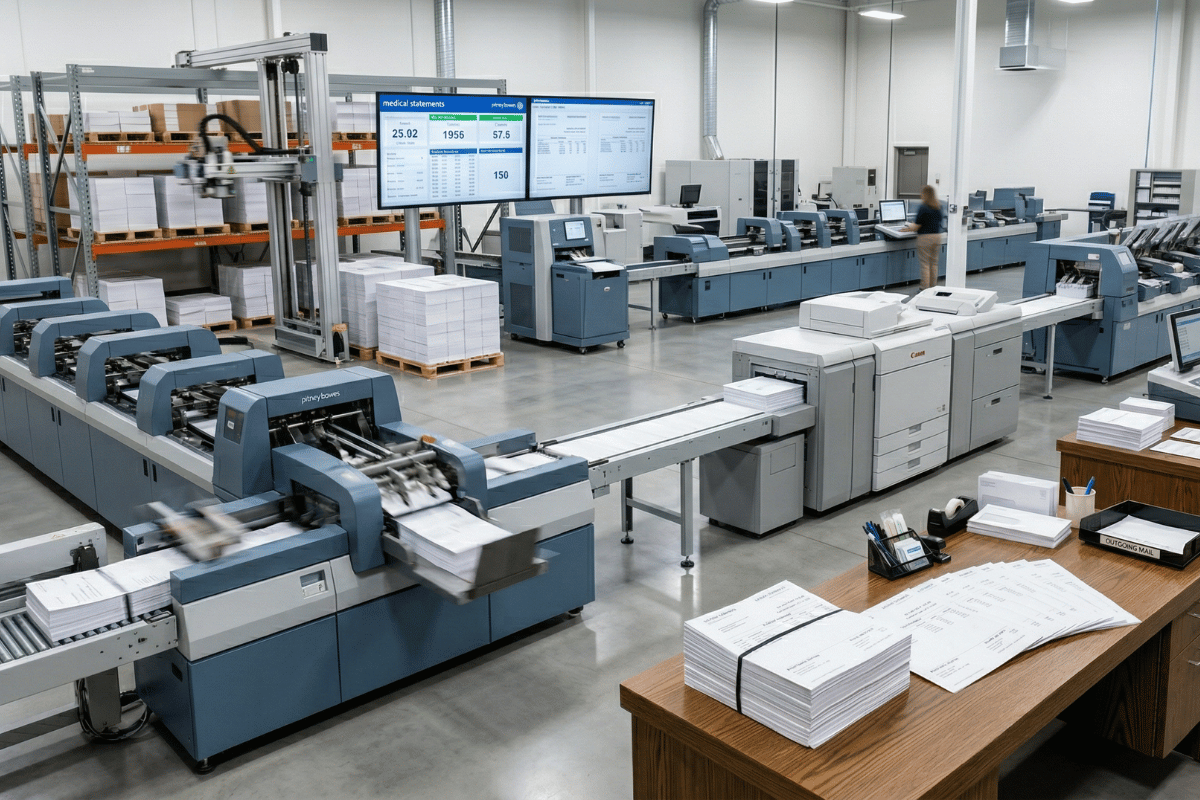
Growth is supposed to be good news. More customers, more transactions, more communication. But for the teams responsible for printing, preparing, and mailing those communications, growth often feels like a problem. Volume increases while headcount stays flat. Deadlines get tighter. Errors become more frequent. Staff members who were hired for other roles end up spending hours each week folding, stuffing, and metering mail.
This is one of the most common challenges organizations bring to Lineage. They need to send more mail, but they cannot justify hiring more people to do it. The solution is not more bodies. It is a better process.
Why Mail Volume Grows Faster Than Teams Can Keep Up
Mail volume rarely increases in a gradual, predictable way. A healthcare network adds a new practice location and suddenly has thousands of additional patient statements to send each month. A government office takes on a new compliance requirement that triggers a wave of public notices. An insurance company launches a new product line and the volume of policy documents doubles overnight.
In each of these scenarios, the mailing workload jumps. But the budget for new hires does not follow at the same pace. Organizations are left trying to push more mail through the same staff, the same equipment, and the same processes that were already stretched thin.
The result is predictable. Deadlines slip. Errors increase. Staff morale drops. And the organization starts absorbing hidden costs in overtime, reprints, return mail, and missed revenue.
The Three Levers That Scale Without Headcount
There are three primary ways to increase mail output without adding staff. Most organizations benefit from a combination of all three, and the right mix depends on volume, industry, compliance requirements, and how much of the process you want to keep in-house.
1. Automate the Manual Steps
The most time-consuming parts of any mailing operation are the manual ones. Folding letters. Stuffing envelopes. Applying postage. Verifying that the right document is going to the right person. These tasks are repetitive, error-prone, and difficult to scale with human labor alone.
Folder inserter systems eliminate the bottleneck by automating the entire document-to-envelope process. A modern inserter can fold, collate, stuff, and seal thousands of pieces per hour with intelligent barcode matching that ensures every document reaches the correct recipient. What takes a team of three people an entire afternoon can be completed by one operator and a machine in under an hour.
Mailing systems with integrated weighing and rate calculation apply the exact correct postage to each piece automatically. This removes guesswork, eliminates overpayment, and keeps your operation compliant with current USPS Intelligent Mail Indicia (IMI) requirements.
Addressing and data quality software cleans and standardizes addresses before mail is produced, reducing return mail and the labor-intensive rework that follows every undeliverable piece.
Together, these tools allow a small team to handle the output that would otherwise require a much larger one.
2. Streamline with Document Management Software
Automation at the machine level is only part of the equation. The other half is what happens before documents ever reach the printer or inserter.
Many organizations lose significant time to disorganized file handling, manual print routing, and ad hoc processes for generating and approving outbound documents. Staff members toggle between systems, print in batches that do not align with mailing schedules, and manually track what has been sent and what has not.
Document management software centralizes these workflows. It allows organizations to generate, store, track, and route documents through a single platform. Business rules can be configured to automatically sort and group documents by recipient, department, or mailing type. Print jobs can be queued and optimized for efficiency rather than handled one at a time.
The productivity gains here are not dramatic in any single step. But across dozens of daily tasks and hundreds of weekly mailings, the cumulative time savings are substantial. Staff spend less time managing the process and more time on work that actually requires human judgment.
3. Outsource What Does Not Need to Happen In-House
For many organizations, the most effective way to scale is to stop trying to do everything internally. High-volume, recurring mailings like monthly statements, billing cycles, policy renewals, and compliance notices are ideal candidates for outsourcing to a secure production partner.
Outsourced print-to-mail services handle the entire process from data file to USPS induction. The organization sends a file, and the outsourced partner prints, assembles, meters, and mails the finished pieces from a secure, HIPAA-compliant facility. No equipment to maintain. No seasonal staffing challenges. No floor space dedicated to mail production.
Outsourcing also unlocks postage savings that are difficult to achieve in-house. Mail presorting organizes outbound mail by ZIP code and carrier route before it enters the postal system, qualifying for USPS workshare discounts. These discounts are typically only available at volumes and sort levels that require dedicated presorting infrastructure, which is exactly what an outsourced partner provides.
Organizations that want to understand the potential savings can use the Lineage presort calculator to estimate how much they could reduce postage costs based on their current mail volume.
A Hybrid Approach Often Works Best
Scaling mail operations is not an all-or-nothing decision. Many organizations find that the most practical solution is a hybrid model.
Routine, high-volume mailings go to an outsourced partner where they can be produced at scale with consistent quality and built-in compliance. Time-sensitive or ad hoc mailings stay in-house, supported by the right mailing equipment and software. Address data is cleaned and verified at every stage, whether the mail is produced internally or externally.
This approach gives organizations the flexibility to handle peaks without scrambling and the efficiency to manage daily operations with a lean team. It also provides a built-in disaster recovery layer. If internal systems go down or a key staff member is unavailable, the outsourced partner keeps critical communications moving.
What Scaling Looks Like in Practice
Consider a mid-size medical billing office that processes 8,000 patient statements per month. With a small administrative team handling mail manually, the process takes several days each cycle. Errors are common. Postage is overpaid. Return mail runs around 5 percent.
After implementing a folder inserter, upgrading to a modern mailing system, and moving the highest-volume runs to an outsourced partner, the same office processes the same volume in a fraction of the time. Return mail drops below 2 percent. Postage costs decrease through presorting. And the administrative team reclaims hours each week that can be redirected toward patient follow-up and collections, which is the work that actually drives revenue.
No new hires were needed. The investment was in process and equipment, not payroll.
Start with an Assessment
Every organization has a different mix of volume, equipment, staffing, and compliance requirements. The right path to scaling depends on where the current bottlenecks are and what combination of automation, software, and outsourcing makes the most sense for your operation.
Lineage has spent more than 38 years helping organizations across healthcare, legal, government, financial services, and insurance find that balance. Whether you need to upgrade your in-house capabilities with Lineage Accelerate or hand off high-volume production to Lineage Connect, we can help you build a mailing operation that grows with your business instead of holding it back.
Schedule a free business assessment to find out where your mail operations can scale without adding headcount.